
News
CSES-01 detection of Haiti Earthquake in 2021
On August 14, 2021, a magnitude 7.2 earthquake struck Haiti, causing widespread destruction across the southern peninsula of the island. While rescue operations began on the ground, the CSES-01 satellite was collecting electromagnetic measurements over the epicentral region during and after the main shock, offering a unique perspective on the seismic event from near-Earth space.
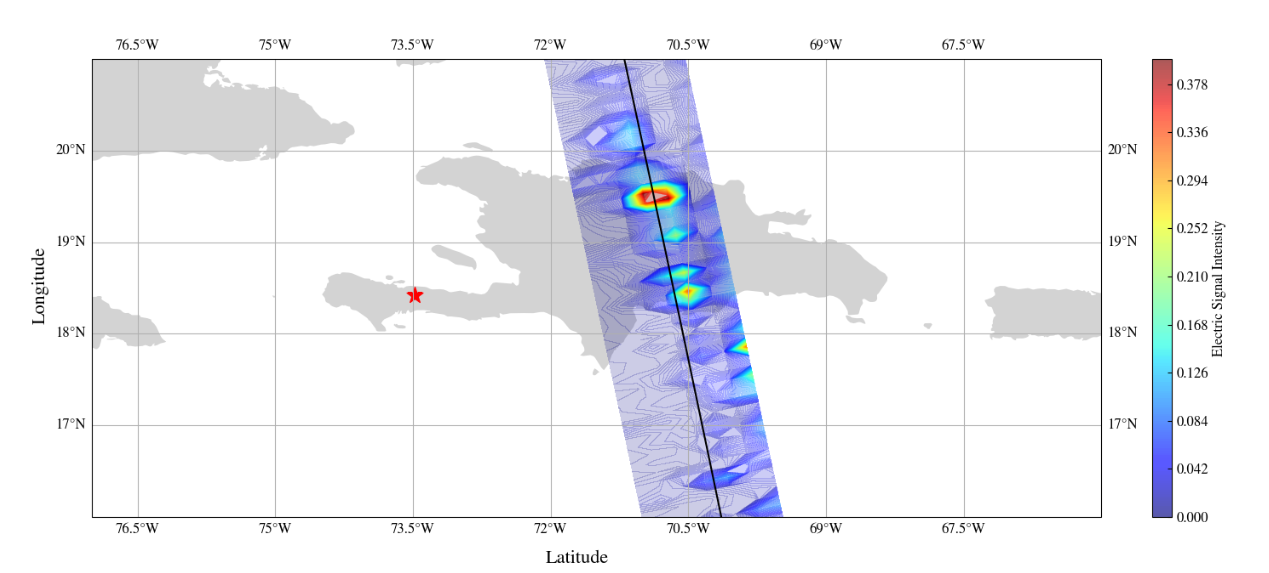
The electric field detector on board CSES-01 detected a sharp electromagnetic anomaly: a concentrated energy peak near 300 Hz localized directly above Haiti. As shown in figure, the signal is clearly visible along the satellite’s trajectory and intensifies over the land matching the zone struck by the earthquake.
This localized electromagnetic signature is interpreted as a direct detection of the earthquake from orbit. This observation is consistent with the LAIC framework (Lithosphere–Atmosphere–Ionosphere–Magnetosphere Coupling) — a theory proposing that a strong earthquake does not only shake the ground, but sets off a chain of disturbances that propagates upward through the upper Earth system layers. According to this framework, the seismic rupture generates acoustic gravity waves that rise through the atmosphere, disturb the ionospheric plasma layer, and ultimately affect the magnetosphere hundreds of kilometers above the Earth’s surface. Thanks to its electric field detector and complementary plasma and magnetic field sensors, CSES-01 is one of the few platforms capable of observing this phenomenon through multi-instrument measurements, from the ground to near-Earth space, discriminating seismic signals from solar space weather perturbations.
CSES-01 is orbiting Earth since and has been joined since June 2025 by its companion satellite CSES-02, expanding the mission’s monitoring capability with new and improved instrumentation. The two satellites, placed in the same orbit but with opposite local times, now provide complementary coverage, strengthening our ability to detect and characterize ionospheric disturbances associated with seismic events on a global scale.
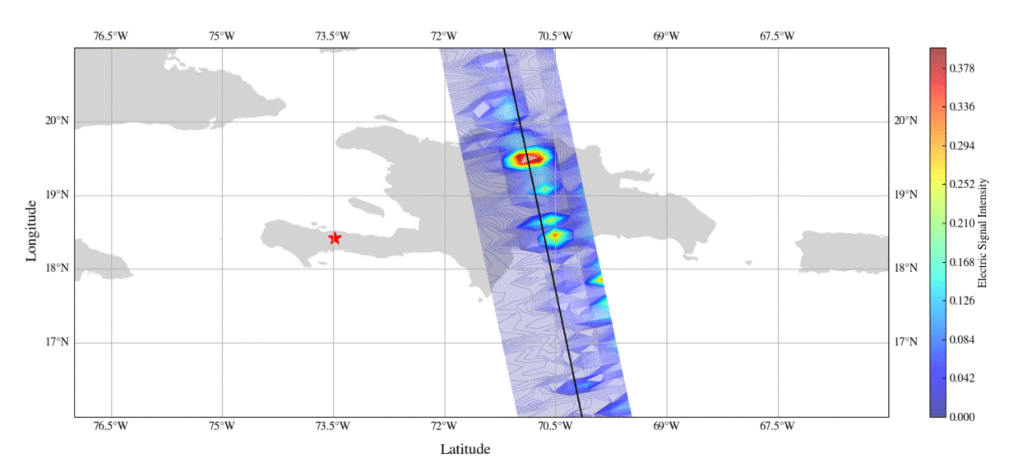
Figure: Colored contour of the Electric Field anomalous signal at around 300 Hz, as recorded by CSES-01 above Haiti. The color bar varies according to the intensity of the peak.The black line denotes the orbit of CSES-01 above Haiti. The epicenter is highlighted with a red star. Credits: Limadou Team
References
D’Angelo et al. (2022), Remote Sens., 14, 5340. https://doi.org/10.3390/rs14215340
Piersanti et al. (2020), Remote Sens., 12, 3299. https://doi.org/10.3390/rs12203299
Papini et al. (2025), Remote Sens., 17, 3417. https://doi.org/10.3390/rs17203417