
News
CSES-02 detecting whistlers: what sound does lightning make in the ionosphere?
The Italian-built Electric Field Detector (EFD-02) has begun its scientific observations onboard the CSES-02 satellite mission, already providing new insights into space phenomena that are still not fully understood—such as the sudden and unpredictable electromagnetic signals generated by lightning and known as whistlers.
But what exactly is a whistler? When lightning strikes, it generates an electromagnetic wave that can travel through the atmosphere all the way to the ionosphere, where it propagates along the Earth’s magnetic field lines. As the signal moves through space, it gradually separates into different frequencies -much like white light splits into a rainbow when it passes through a glass prism.
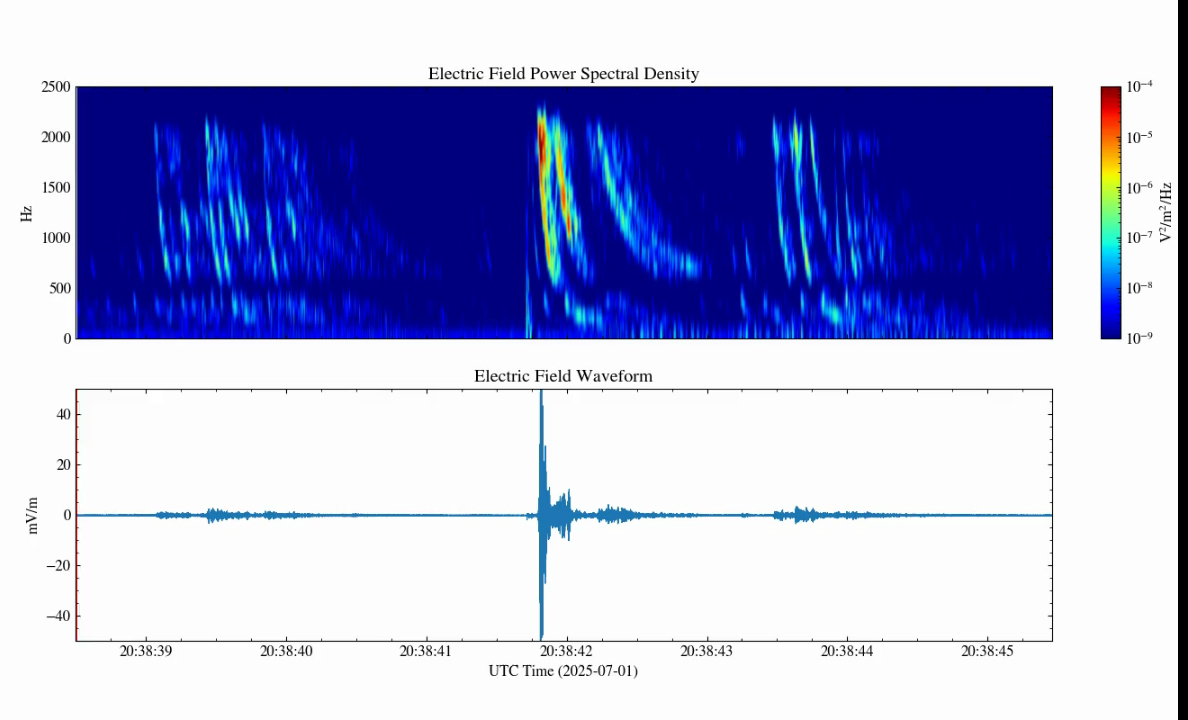
This process produces what scientists call a whistler: the electromagnetic echo of a lightning strike. Because higher-frequency waves travel faster than lower-frequency ones, the signal becomes stretched in time and takes on a characteristic “comma” shape, like the one shown in the figure below recorded by EFD-02 onboard CSES-02. If converted into sound, this steadily signal resembles a whistle that shifts from higher to lower notes—hence the name of the phenomenon.
Detecting whistlers is notoriously challenging due to their short duration and rapidly changing frequency, but these signals are scientifically valuable because they provide information about the density of electrons in the near-Earth space they are crossing.
A detection of a “whistler”: the electromagnetic echo of a lightning strike traveling through space. The EFD-02 instrument measures its decreasing frequency, a signature that makes the signal resemble a descending whistle.