Italian instruments on CSES-02 monitor effects of the solar storm
The Italian instruments HEPD-02 and EFD-02 on board the CSES-02 satellite have recorded the passage of a Space Weather event (a powerful solar storm) that triggered spectacular auroras that were visible across Europe, including Italy, between 19 and 20 January 2026. This phenomenon is very rare at our latitudes and attracted great attention from both the general public and the scientific community, offering a rare opportunity to observe through direct measurements the interaction between energetic particles originating from the Sun and Earth’s near-space environment.
The event was triggered by a powerful X-class solar flare that occurred on 18 January 2026 at 18:09 UTC, associated with a coronal mass ejection (CME), charged particles ejected from the Sun and directed toward Earth. Upon the arrival of this material, the Earth’s magnetosphere entered a phase of strong disturbance, generating an intense geomagnetic storm. The event produced a significant influx of energetic particles, particularly protons accelerated by the solar flare.
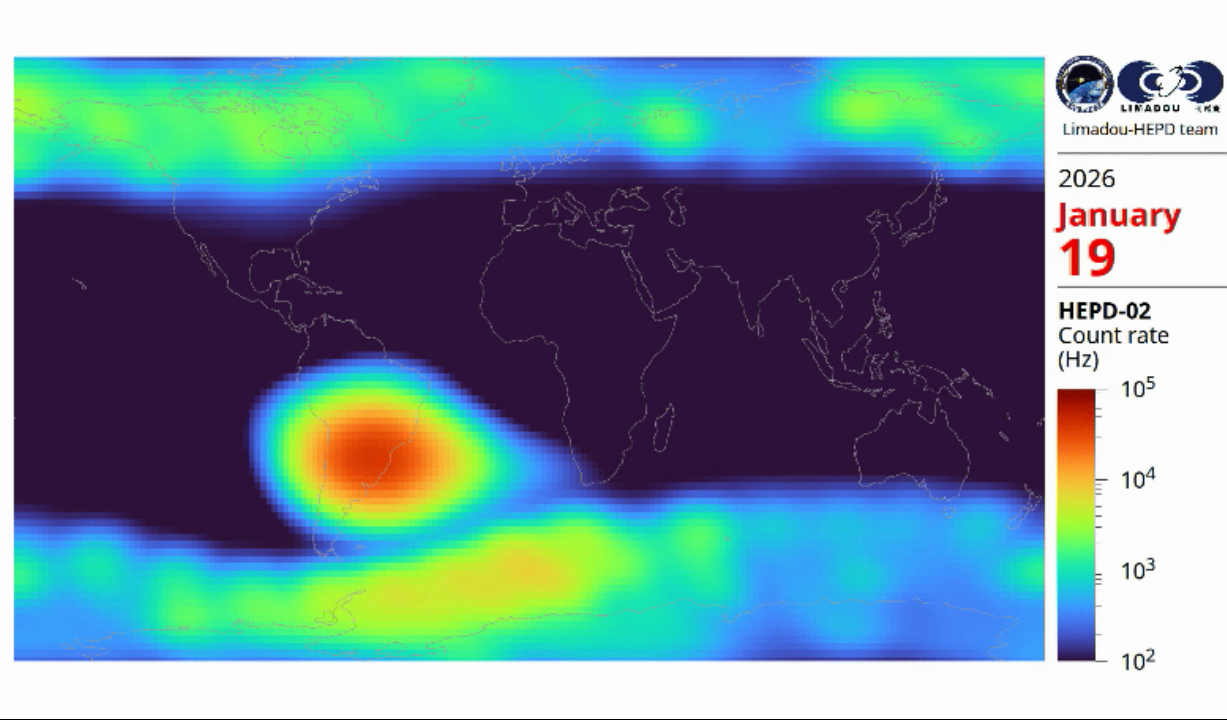
During the event, the HEPD-02 clearly detected a sudden increase in the particle flux across a wide energy range, as shown in the video representing the radiation intensity measured over the Earth’s globe from January 1 to January 24, 2026 (Figure 1 shows two screenshots of the video for comparison; Figure 2 shows the temporal trend of the number of particles measured).
EFD-02 simultaneously highlighted the phenomenon by measuring electric fields during the main phase of the geomagnetic storm, when the coronal mass impacted the Earth’s magnetosphere . Figure 3 shows electric field measurements along the satellite’s trajectory over the Northern Hemisphere. The trace shows how auroral electric activity is very low prior to the storm (blue arrow that points at measurement taken on the 19th of January, at 19:20 UTC), followed by a dramatic intensification during the main phases of the geomagnetic storm (red arrow, taken at 21:40 UTC) expanding over a wider area, eventually reaching even our latitudes..
The event is still ongoing, and the CSES-02 satellite, thanks to the Italian instruments of the Limadou collaboration, will continue monitoring its development with high precision. These measurements represent a first, significant example of the instruments’ capability to monitor the Sun–Earth environment in near real time, advancing our understanding of Space Weather phenomena and the impacts on our planet Earth.
Video: A video of the particle flux measured by HEPD-02 from January 1 to January 24, 2026 before and during the geomagnetic storm. Credits: Limadou Collaboration
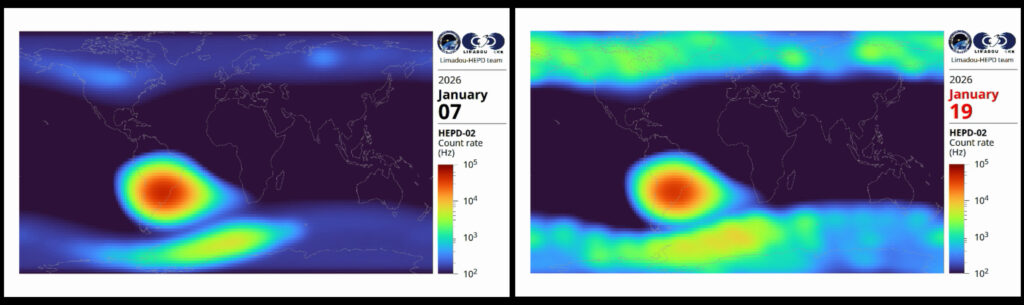
Figure 1. Two screenshots from the HEPD-02 video: comparison of the particle flux before and during the geomagnetic storm (January 7 and 19). Credits: Limadou Collaboration
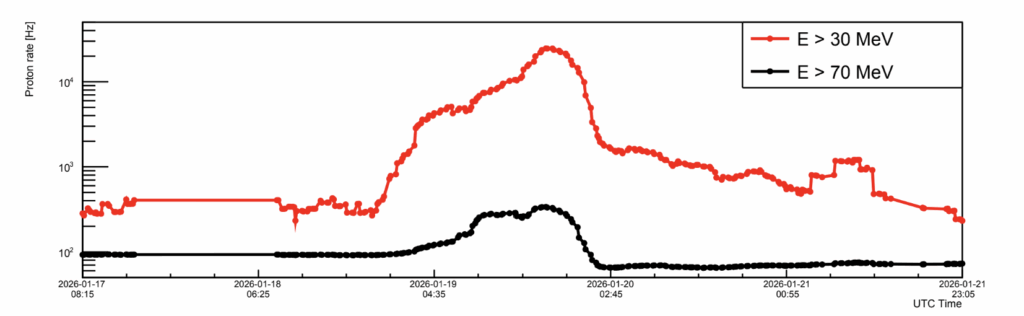
Figure 2: The plots show the temporal evolution of the particles measured by HEPD-02 in two energy ranges (>30 MeV in red and >70 MeV in black), showing a significant increase coinciding with the arrival of the event in the magnetosphere. Credits: Limadou Collaboration
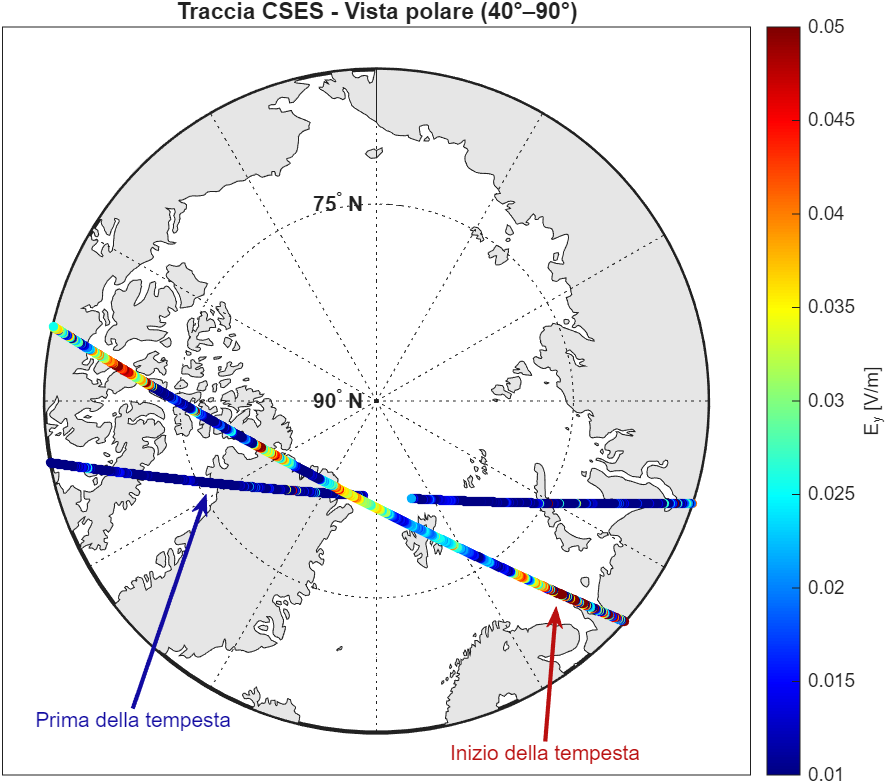
Figure 3: Electric field measured by EFD-02 along the trajectory of the CSES satellite over the Northern Hemisphere. The trace shows how auroral electric activity is very low before the storm, (shown in blue, measured on the 19th of January at 19:20 UTC), then intensifies with the arrival of the storm (shown in red, measured at the 21:40 UTC of the same day) over a wider area, eventually reaching even our latitudes. Credits: Limadou Collaboration